Virginia Revel—Bill Eversleigh
The Secret of ChimneysVirginia Revel and Bill Eversleigh have an intimate, affectionate friendship whose central imbalance is plain: Bill loves Virginia and repeatedly wants to marry her, while she cherishes him but does not accept his proposals. Their exchanges make the distinction between closeness and romantic commitment a recurring source of comedy, tenderness, and frustration.
The Shape of Their Relationship
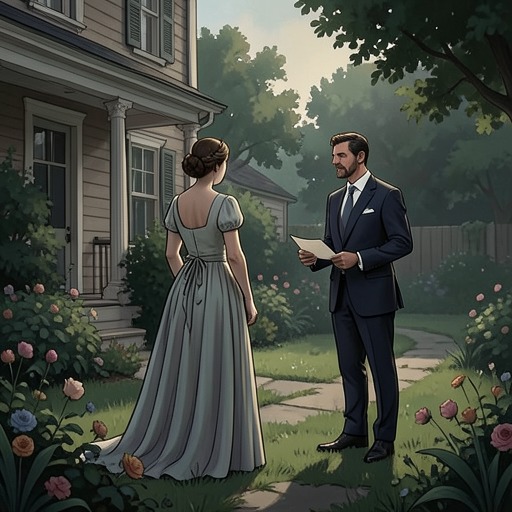
Bill’s attachment is persistent, and Virginia knows it well. When he finally gets an opportunity to speak with her after a day occupied by other demands, he declares that he loves her. Virginia asks him to be gentle because she feels close to tears, but she does not take that vulnerability as an invitation to propose. Instead, she tells him that she is not strong enough for such a conversation and jokes that respectable people do not propose before lunch. Bill’s readiness to propose even before breakfast underscores how little the timing matters to him: the desire is always waiting for an opening.
Virginia names the pattern directly when she asks Bill to be sensible and listen to her. Proposing, she says, is his fixed idea; men propose when they are bored and have nothing else to say. She reminds him that she is a widow and points him toward a young woman instead. Her response is not coldness: she addresses him as “my darling Virginia” is not the phrase she uses—rather, Bill himself calls her “my darling Virginia,” and the evidence presents that endearment as his, not hers. The affection is genuine, but it does not erase her clear refusal to treat marriage as the natural next step in their friendship.
Intimacy and Playful Familiarity
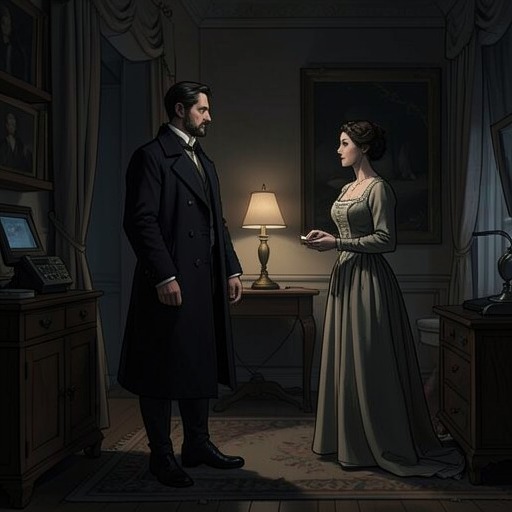
Their ease with one another appears in the personal details they notice and tease each other about. In a late-night scene, Virginia remarks on Bill’s pyjamas, praising their brightness without vulgarity. Bill, meanwhile, asks about the green garment she is wearing, and she identifies it as a negligée. Their conversation turns into affectionate banter about Bill’s experience and respectability; Virginia says he has just betrayed that he has led a pure life. The humor depends on familiarity rather than formality: they can discuss clothing and sexual innocence without losing their easy companionship.
Virginia even offers the possibility of a kiss, but frames it as a future, carefully scheduled event: perhaps the next morning around ten, a safe hour that would not unduly excite the emotions. Bill prefers the spur of the moment. Her teasing promise momentarily brings romantic intimacy within reach, yet the scene does not establish that the kiss occurs or that her attitude toward marriage changes. When they have more urgent matters to attend to, Virginia briskly redirects them to the task at hand. Affection and flirtation coexist with her ability to set the terms of the encounter.
Jealousy, Frustration, and Devotion
Bill’s feelings are also visible in his private reactions. After a day when George Lomax’s demands leave him with little chance to speak to Virginia, Bill feels exhausted, injured, and ill-used. He is relieved when Anthony Cade leaves, believing that Anthony has monopolized too much of Virginia’s company. The resentment is not a stated quarrel with Virginia; it reveals Bill’s anxious awareness of rivals for her attention and his wish for a larger place in her life.
That night, his dream stages the wish as farce. Bill plays the heroic rescuer carrying Virginia from a burning building, but the fantasy repeatedly collapses into distractions: sandwiches, George Lomax dictating telegrams, Bill’s pyjamas at a church wedding, a car without petrol, and Virginia arriving with the bald-headed Baron. Virginia appears cool and elegantly dressed, then wakes Bill by shaking him. The sequence turns his romantic self-image into comic disorder: even his imagined rescue and wedding cannot proceed without interruption, embarrassment, or a rival.
Boundaries and Continuing Affection
Virginia’s later conversation with Bill makes the asymmetry explicit without severing their bond. She asks for his advice, and he answers by suggesting that marrying him would make her happier and more settled. She counters that he should stop proposing and direct his courtship toward someone else. Bill’s declarations therefore recur even when Virginia redirects him; her teasing and tenderness soften the refusals but do not convert them into consent.
The relationship remains one of close companionship and one-sided romantic devotion in the evidence presented here. Virginia can confide in Bill, joke with him, and even entertain a kiss as playful possibility, while retaining control over whether the friendship becomes a courtship or marriage. Bill’s constant proposals and his jealousy at Anthony’s company keep his hope alive; Virginia’s affectionate deflections preserve their intimacy while making clear that her widowhood and wishes are not an automatic answer to his persistence.